


The Data Fact Gap
August 6, 2014 by Julia·
Leave a Comment
As professionals, we all know that technology has changed the way we do business. Whether you find the increased dependence on new technology as good or bad often depends on how effectively the tools are used. Over the years, this problem has been illustrated in many ways by Stics and a variety of other experts.
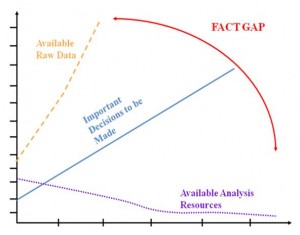
Fact Gap Graph
This particular Fact Gap illustration was first attributed to the Gartner Group. It will help us describe how data technologies are, on the one hand, progressing and on the other, creating new data analysis problems.
The “Data Fact Gap” was created by the explosion of available digital information accumulated in recent years. With technology system advances, increased data storage capacity and Internet usage it is now easy to collect mountains of data. While the volume of retained data has grown exponentially and spread across all industries, so have the data management challenges it created and the even greater marketing opportunities that mostly lie dormant.
This abundance of data creates new problems that force database marketers to devote a lot of time and resources to filtering information into data segments so decision makers can frame a concept, problem or question. While this approach is intuitive to the human brain, it does limit our ability to make a fully informed decision from all available data.
Why You Need Good Data
Intuitively we often think we already know what our customers want. However, that is not always the case. When we make business decisions by filtering our data down to a few variables we miss the more accurate and complete view of the data. Without hard data, there’s no way to be sure truly objective decisions are being made. Worse, because we think we’re making objective decisions, we often don’t seek an outside perspective.
What we really need is an objective analysis, wielding as many customer factors and data points as possible. This approach helps us see the potential hidden below the common database marketing analysis.
Statistical Predictive Analytics Solves the Problem
One way to harness the data explosion and make better marketing and business decisions is to use predictive analytics. Predictive analytics uses the science of statistics and is capable of considering unlimited facets of a situation. Predictive analytics for marketing can increase a marketing campaign’s return on investment by 10 times compared to a typical SQL analysis that might only evaluate (about) five variables. It takes the data that you already have and gives you information you can use in your marketing campaigns, such as:
- Identifying customers you are currently marketing to who are unprofitable or about to reach the end of their customer lifetime value
- Identify high value customers hiding in your database or prospects you are not marketing to
- Suggest more profitable marketing programs
- Identify the lifetime value of various members in your customer base
Statistical modeling with predictive analytics is proven to help make more informed decisions and increase profit margins.
Stics lives on the front lines of customer data knowledge generation. We have a deep understanding of the problems and opportunities created by the data explosion. For that reason, we discourage installing expensive applications that might not provide quick answers to important questions that drive revenue and profitability. We know that with seasoned expertise, a leading statistical technology platform and focused services like ours, it is possible to bridge the data gap and quickly and easily improve the performance of your marketing campaigns.
Stics offers innovative solutions that provide deeper insight into your customer and loyalty database for greater marketing return on investment. We welcome inquiries and are happy to answer questions. We’re waiting to talk to you. Let us know what’s on your mind.
Change Your Game with Predictive Analytics
March 18, 2012 by Stics·
Leave a Comment
Predictive analytics continues to get a lot of attention not only in the corporate world but in the sports industry as well. With the release of the movie Moneyball, more people have become aware of how predictive analytics can be a game changer not only in business but even in sports.
Billy Beane and Paul DePodesta were able to transform the business of professional baseball through predictive analytics. Sabermetrics is the specialized analytics used to analyze baseball records and make determinations about player performance. Sabermetrics is now used by some of the most popular baseball teams in the country including the New York Yankees and Boston Red Sox.
Hit a Home Run Faster
Predictive analytics can help your casino gaming business hit a home run faster than you could ever imagine. Here are a few lessons from the movie that you can also apply to help improve your business performance:
- Gain Competitive Edge – Don’t you want to know who your best customers are? Their behaviors? Average daily worth or profitability, reinvestment rates, probability of responding to an offer? With predictive analytics, you can find answers to some of the toughest questions in the casino gaming industry.
- Confident Decision Making – Oftentimes, data diverge from our expectations that we become doubtful of our decisions and more afraid to take risk. However, predictive analytics can back you up with for making the most bizarre decisions for your business.
- Better-Informed Decisions – Decision-makers used to rely on intuition and were exposed to biases most of the time. With predictive analytics, no more shot-in-the-dark decisions. Data-driven decisions can bring you better predictions and more efficient results.
- Your Data is Your Asset – Gathering data is just as important as interpreting it. Through predictive analytics, you are able to unlock the potential of your old data and make better-informed decisions that eventually lead to your organization’s success.
- Focus on the Right Data – Everyday your organization gathers a huge amount of data, but make sure you give emphasis on things that matters most to your business. Your data is your asset but it’s also an investment, don’t waste your efforts on meaningless data.
- Invest Wisely – It’s obvious that acquiring a new customer is much more expensive than keeping one. Whether you own a small By investing on analytic tools, you won’t have to change your marketing team just to generate new ideas. Predictive analytics can provide you evaluations traditional marketers do not see.
- Choose the right expert – Look for the right person or team for the job. Analysts are everywhere but choosing the ones who are specialized and knowledgeable in your industry would be of better than hiring a team of analysts from a different field of expertise.
Stics helps organizations leverage information by transforming data into insight – not complexity. With Stics, as your predictive analytics partner, you achieve business goals faster, focus on your core business, and gain a fast 10X ROI.
Call us if you would like to learn more. We are here to help.
Casino Gaming Database Marketing Strategies
August 19, 2011 by Stics·
Leave a Comment
No Change in Database Marketing Strategies
Another fact we learned from our casino marketing survey was that most casino properties stuck with their existing db marketing strategies, even with the downturn. Basically, we found that:
- Despite the status of the business, almost 40% (39.1%) of properties are not changing their db marketing strategies.
- About a fourth of the industry is simply adjusting their marketing budget. More properties are increasing spending (17.4%) than decreasing (8.7%) marketing spending as a response to the situation.
- Another quarter (26.1%) are mailing different individuals with the same budget.
- Another 8% of properties are dealing with industry situation by buying new machines.
Strategies for db Marketing
The survey revealed that the gaming industry moved toward more tiering.
- 27% used Three-tiered database
- 42% mail 4- 12 tiers
- 12% mail at least 25 tiers
- 19% did not use or not known
Opportunity to improve mailing sophistication
Stics believes there is a lot of opportunity to database market more effectively. Based on the survey results, campaign effectiveness can be improved by:
- Trying new things (because 40% were mailing same)
- More complexity (because 69% were mailing fewer than 12 tiers)
- More Sophistication (only 23% using predictive analytics)
At a high level we know that loyal customers do come back, they just don’t spend as much. The problem is knowing which customer are likely to have more money to spend and how to bring back less frequent customers. Stics can help with that. Stics can unlock the power of your current database to maximize profitability and marketing effectiveness. For more information, call us today. We are here to help.
Casino Gaming Pain Points
July 1, 2011 by Stics·
Leave a Comment
 Reduced Revenues from Same Number of Players the No. 1 Pain Point
Casino businesses have diverse pain points, so we narrowed them down to find out which is the biggest source of pain last year. According to our survey, these were the pain points of businesses last year:
- Increase spend of players already coming (28%)
- Get new customers to make up for the deficit in current play (24%)
- Get players to play more since spending less (20%)
- Add other form of spending to mix (12%)—stays, events, food, etc.
- 4% changing reinvestment
With 57% of our respondents in their positions for less than 2 years, companies seem to be making investments in marketing talents to improve results. However, it appears that getting the same number of players to spend more is the top source of pain by their marketing people.
Stics, as your predictive analytics partner, can help you find your pain points and determine effective marketing solutions that can achieve 10x ROI fast.
If you would like to learn more, call us today. We are here to help.
Casino Gaming Business Performance
June 10, 2011 by Stics·
Leave a Comment
More Up’s than Downs for Casino Gaming
We wanted to know how much the overall business performance in the casino gaming industry has changed in the previous year and our survey reveals that there actually has been more “up’s” than “down’s” as compared to the previous year.
More companies have improved in their performance than those who experienced decline; even so, most businesses yielded flat in their performance. This is vis-à-vis last year; so bottom hit for some.
- Things are better in places than expected (30.8% of businesses are up)
- More are up than down (30.8 up and 23.1 down)
- No improvement for bulk (61.6%) though (38.5% flat plus 23.1% down)
Stics offers predictive analytics to help you derive insights from your current data, make better informed decisions, and ultimately, improve your business performance. Call us if you would like to learn more. We are here to help.
Casinos & Hospitality Industry Stays Focused on Revenue
May 27, 2011 by Stics·
Leave a Comment
Revenue the Primary Measure of Casino Success

When we asked what are the key metrics used to measure marketing ROI, we found that revenue remained to be the main driver of business assessment in the industry. We also noted:
- About one third of participants use profit
- Most (65.4%) examine gross revenue
- Less than half (46.2%) examine EBITDA suggesting profitability maybe difficult to monitor
- And 34% of the time some additional other variable was also considered
If you are looking to increase revenue and profit at your property, contact Stics. We have solutions that generate millions of dollars each month. Call us if you would like to learn more. We are here to help.
Report Marks Indian Gaming Revenue Decline
March 25, 2011 by Stics·
Leave a Comment
Indian Gaming Still the Recessionary Winner
Indian gaming began its widespread popularity in the States during the late 1980’s and its growth rapidly escalated. Despite the trend, even Indian gaming could not completely escape the impact of the recession, reporting an overall revenue decline of 1% in 2009, as reported in Casino City Press.
Casino City’s latest Indian Gaming Industry Report reveals national Indian gaming revenue declined 1% to $26.4 billion, from $26.7 billion the previous year. This marks it the first year of decline in Indian gaming history. According to the report, the overall slowdown was due to the economy and other factors including, public policies restricting the supply of gaming.
The performance of Indian gaming varied widely across states, California and Oklahoma were the top two states accounting for 38% of the total national Indian gaming revenue.
The overall decline in Indian gaming was much less serious than the commercial casino of the nationwide gaming industry.
Why Did the Indian Gaming Community Do So Well in the Economic Downturn?
Stics believes there are two major factors that contributed to the relative resilience of Indian Casinos over the past few years― and they both relate to location.
High Percentage of Local Gamers
If a property has a higher percentage of local gamers, its resilience in an economic downturn will be greater. Generally speaking:
- In a recession, people travel less.
- If gambling is a preferred form of entertainment, the destination gamble will reduce expenses by gambling closer to home.
- The percentage of gross gaming revenue from local gamers is higher for Native American properties than destination cities.
Less Competition
Native American properties often, but not uniformly, enjoy less competition. This is due to:
- Unique or remote locations
- A scarcity of nearby gaming alternatives
This encourages customer visit stability, as gamblers come back to nearby casinos more consistently over time. Because of this local access, gambling can become a recurring part of the local entertainment budget.
Casino Marketing Trends
September 3, 2010 by Stics·
Leave a Comment
Casino Marketing Survey
Earlier this year, Stics conducted a preliminary research project to gauge the state of the U.S. gaming industry, from a marketing perspective. We contacted both senior level business executives as well as high to mid-level marketing department professionals to learn more about their challenges and perceptions.
Listed below is a high level summary of some of the more interesting observations.
Top 5 Casino Marketing Observations
- Respondents felt their casino marketing efforts were performing well – despite the down economy.
- Direct mail volume of was up by 10 – 20%.
- Marketers put more value on the website and online programs while business leaders didn’t see value in the websites as compared to direct mail and analysis.
- Business leaders are “likely” to “very likely” to invest in new marketing technologies but marketing teams were “very unlikely” to “unlikely” to invest.
- Marketers were concerned about expenses.
While it is obvious that the economy has taken its toll on casino marketers and the gaming industry as a whole, Stics believes that today’s casino marketers are being asked to do more with less. As a result, they are executing on a large number of campaigns to a wider audience. This presents them with the new challenge of how to profitably reach this wider audience.
Stics is currently conducting a more comprehensive study as a follow up to our preliminary findings. We will keep you posted on other interesting facts when they become available.
Stics helps casino marketers reach a wider, more profitable audience through the efficient and effective use of predictive modeling. If you have any questions about predictive analytics for casino marketing, please give us a call. We look forward to speaking with you.
